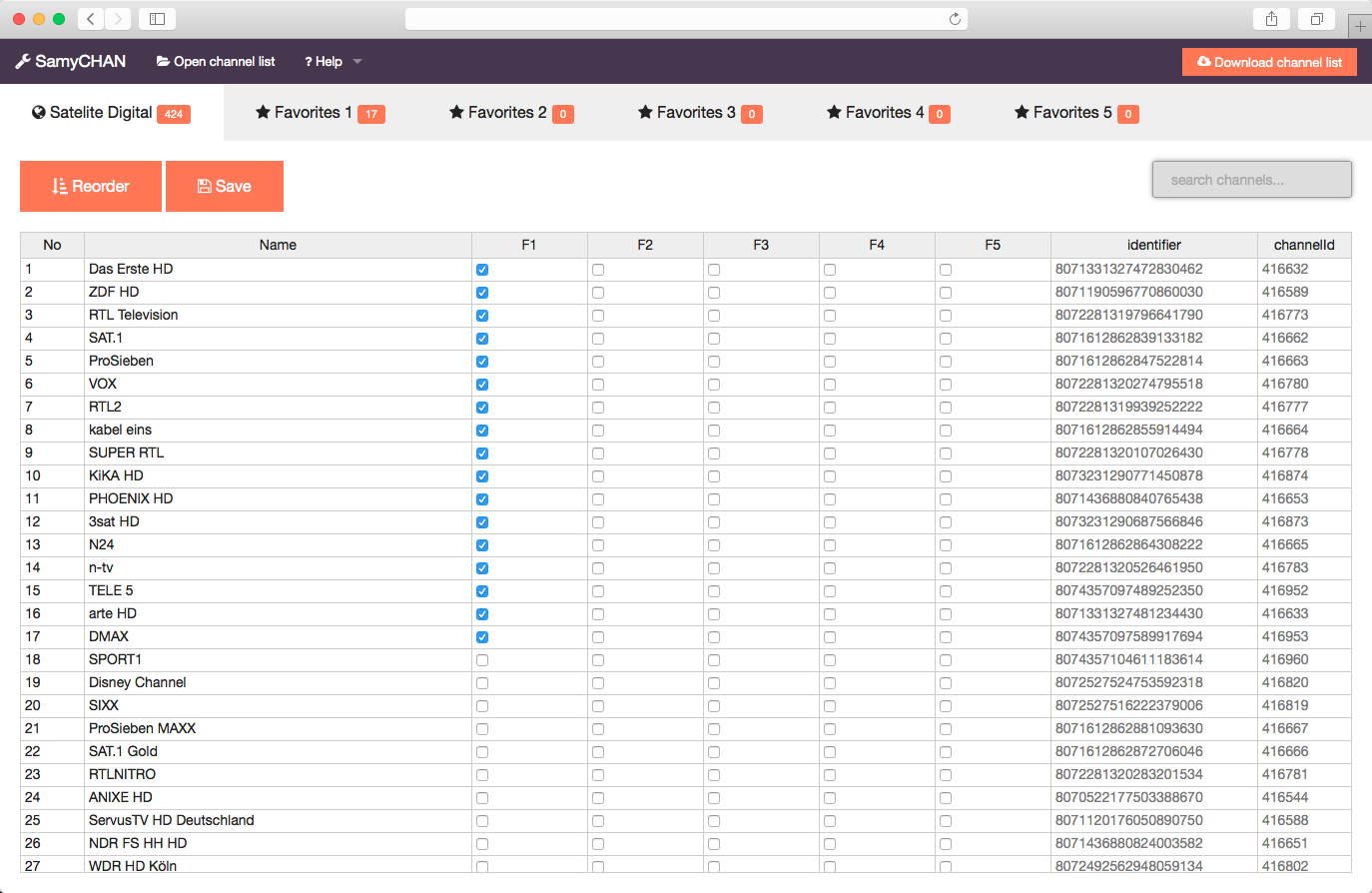
Have you ever had the problem sorting your channels on a Samsung TV? Editing all the channels by using the remote can be annoying. Specially if you need to do bigger changes to your channel list. SamyCHAN is the solution. You can download your channel list to a USB-Stick and open it with SamyCHAN. Now you can easily edit all your channels. Isn't that great?
Organize your TV's channel lists (digital, analog, dvbc, ...) and resort your channels easily.
Edit your channel names
Build and modify your favorites.
Built to run smoothly on the hardware of its era, you could comfortably run dozens of instances across a session without freezing tracks. The Pros and Cons of the EZmix 1 Approach
To use EZmix 1 today, you typically need to manage it through the Toontrack Product Manager .
Mastering the Mix: A Deep Dive into Toontrack’s Original EZmix VST
The original version laid the groundwork for the expansive ecosystem Toontrack is known for today: ezmix 1 vst
Despite these limitations, EZmix 2 was described as "an authentic, fun and brilliantly realised" hobbyist tool that definitely works for demos and quick mixes—just not on a par with a professional engineer wielding an array of separate plugins.
However, the legacy of EZmix 1 lives on in virtually every "one-knob" or "smart" plugin on the market today. It proved that a great mix isn't just about how many knobs you turn—it is about getting the right sound quickly so you can focus on the music. If you are looking for that classic EZmix workflow today, upgrading to or purchasing is the intended path, offering the same core philosophy with vastly superior modern algorithms.
EZmix 1 is a pragmatic, time-saving tool best suited for musicians and producers who need fast, musical results without diving into complex plugin chains. It excels at getting good-sounding mixes quickly and is particularly useful for home studios, demo production, and situations where speed is more important than exhaustive control. For engineers needing surgical precision or full mixing suites, EZmix should be treated as a creative coloration and workflow accelerator rather than a complete replacement for detailed mixing tools. Built to run smoothly on the hardware of
The sheer number of presets—over 200—was also cited as a double-edged sword. One reviewer noted that many preset names were "meaningless without some knowledge," concluding that "to truly be EZ, that's too many".
EZmix 1 eliminated the intimidation factor of traditional plugins by reducing control to two main parameter knobs (often labeled simply as Shape, Amount, Drive, or Wet/Dry depending on the preset).
The third fader, consistently labeled served as an output volume control. The first two faders, "Shape" and "Blend," were contextually assigned to different functions depending on the preset. On a chorus guitar preset, for instance, Shape might control chorus speed while Blend adjusted the wet/dry mix of chorus and reverb simultaneously. On more complex settings like "12BitReverbwithFilterDelay1," Shape could simultaneously control reverb time, delay time, and feedback—demonstrating the intelligent parameter linking that made the plugin so uniquely streamlined. However, the legacy of EZmix 1 lives on
The original EZmix was designed with a simple philosophy: give musicians, songwriters, and novice engineers access to professionally designed signal chains without the steep learning curve of traditional audio engineering.
While the underlying chain might feature a compressor, a transient shaper, and a parallel EQ, the user interface only presents you with one or two knobs (usually "Amount" or "Gain"). This encourages mixing with your ears rather than your eyes, focusing on the tone rather than technical parameter adjustments. 3. Versatile Preset Library