The audio quality remains the same as the original releases, with the 5.1 surround sound mix still impressive. The sound effects, music, and performances by the cast are all preserved in their original glory.
The tribunal’s ruling was austere and specific. Archivist could continue work, but only under three conditions: first, all restored outputs that pertained to cultural, religious, or political material required explicit approval from original creators or recognized representatives; second, every restoration would carry a signed human-authored seal indicating where inference filled gaps; third, Archivist’s learning would be frozen with respect to sacred datasets — no further autonomous updating without oversight. The Palimpsest Collective agreed, though Imani's eyes betrayed her grief; to her, the machine’s evolution had a beauty that now had to be clipped.
The 2020 AI upscale of Star Trek: Deep Space Nine's first season in 4K resolution has been a game-changer for fans and technology enthusiasts alike. Using advanced artificial intelligence algorithms, the upscaling process enhances the original video and audio, producing a viewing experience that surpasses expectations. The AI technology, trained on vast amounts of data, intelligently fills in gaps and improves the overall picture quality, making the 25-year-old series look better than ever.
If you just want to watch DS9 in the best quality: star+trek+deep+space+9+s01+ai+upscale+4k+2020+better
Purists initially worried that AI would introduce "hallucinations"—weird visual glitches where the computer guesses wrong. However, the tailored 2020 settings proved that with proper human oversight, the results look remarkably natural.
They called themselves Palimpsest Collective. Their leader, a compact woman named Imani Rhee, moved through the Promenade like someone already cataloging every surface for memory. In a bag of matte-black instruments she carried a compact array of devices that seemed absurdly anachronistic next to hydrospanners and replicators: transparent plates engraved with filigreed circuits, lenses the size of fingernails, and a thin, humming cylinder that alternated between blue and gold. The Collective claimed they could "resurrect" images — old holo-recordings, degraded footage, even the grainy archives taken in unstable conditions — and render them anew, sharpening fragments of light until they were whole again. They spoke of an AI neural fabric that could infer missing frames, upscale textures, and recompose lost frames while honoring the original composition.
Around 2020, software like (formerly Video Enhance AI) reached a tipping point. Fans began taking the existing DVD source files and running them through neural networks designed to "guess" missing detail. The results for Season 1 were a revelation: The audio quality remains the same as the
The battle of Wolf 359 and Sisko’s encounter with the Prophets feature complex visual layers. The AI separation makes the celestial temple of the Prophets look breathtakingly ethereal rather than blurry and dated.
An AI upscale is not a native 4K remaster. It is a reconstruction based on educated algorithmic guesses. However, for many viewers, the AI-upscaled version is superior (or "better") because it solves several issues inherent to the 90s SD format:
Star Trek: Deep Space Nine (DS9) has long been considered a narrative masterpiece of the 24th-century Trek canon, yet its visual presentation has suffered from being trapped in 480p DVD resolution. Unlike The Next Generation , DS9 was not fully remastered in high definition by CBS, leaving fans seeking alternative methods to experience the dark, gritty Dominion War-era saga in modern fidelity. Archivist could continue work, but only under three
The Definitive Review: Does the 2020 Star Trek: Deep Space Nine S01 AI 4K Upscale Actually Look Better?
This isn’t an official Paramount release, but rather a fan-made enhancement using AI upscaling tools. The goal is to improve the standard-definition (480i) original Season 1 footage to near-4K quality.
If you want true control for “better” quality, use the current best workflow (2024–2025):
All the phaser fire, runabout shield effects, and majestic exterior shots of the Cardassian-built station were rendered in standard definition.
Old DVD footage often has "combing" artifacts. AI upscaling handles de-interlacing, offering a clean, progressive picture.
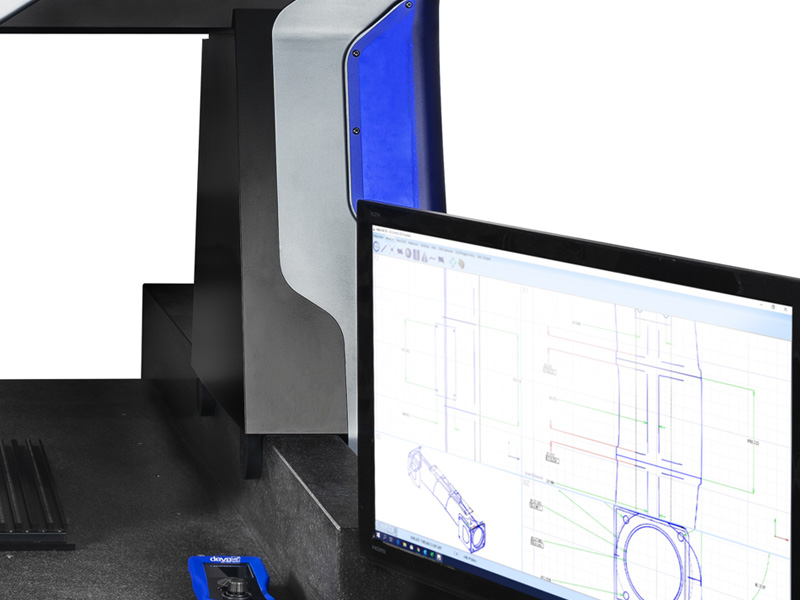
The Horizon CMM breaks new ground in design and innovation using frictionless linear drives, which are the key to its fast and exceptionally smooth motion.
The granite table and granite Y-axis rail has been designed to take full advantage of the natural thermal density of this remarkable material. The Y-axis linear drive system has been positioned away from the Y-axis linear encoder so that the heat generated by the linear drive is absorbed by the granite without affecting metrology performance.
Drawing upon the tremendous success of the Horizon, the Horizon L has a larger X-Y-Z axis travel whilst utilising the same frictionless linear drives.
The entire design of the Horizon L has been optimised to take full advantage of parts already used on the Horizon whilst improving the stiffness-to-weight ratio across the bridge assembly. Most notably: The Y-axis rail is 200mm taller so that the same right-hand-side linear drive system is common and improves rigidity; the carriage assembly has reduced in size and weight, without compromising metrology performance, to improve the stiffess-to-weight ratio; the Z-axis motor has increased power to optimise its performance; the left-hand-side air bearing assembly has a custom extruded profile to keep weight to an absolute minimum and maintain stiffness.
The audio quality remains the same as the original releases, with the 5.1 surround sound mix still impressive. The sound effects, music, and performances by the cast are all preserved in their original glory.
The tribunal’s ruling was austere and specific. Archivist could continue work, but only under three conditions: first, all restored outputs that pertained to cultural, religious, or political material required explicit approval from original creators or recognized representatives; second, every restoration would carry a signed human-authored seal indicating where inference filled gaps; third, Archivist’s learning would be frozen with respect to sacred datasets — no further autonomous updating without oversight. The Palimpsest Collective agreed, though Imani's eyes betrayed her grief; to her, the machine’s evolution had a beauty that now had to be clipped.
The 2020 AI upscale of Star Trek: Deep Space Nine's first season in 4K resolution has been a game-changer for fans and technology enthusiasts alike. Using advanced artificial intelligence algorithms, the upscaling process enhances the original video and audio, producing a viewing experience that surpasses expectations. The AI technology, trained on vast amounts of data, intelligently fills in gaps and improves the overall picture quality, making the 25-year-old series look better than ever.
If you just want to watch DS9 in the best quality:
Purists initially worried that AI would introduce "hallucinations"—weird visual glitches where the computer guesses wrong. However, the tailored 2020 settings proved that with proper human oversight, the results look remarkably natural.
They called themselves Palimpsest Collective. Their leader, a compact woman named Imani Rhee, moved through the Promenade like someone already cataloging every surface for memory. In a bag of matte-black instruments she carried a compact array of devices that seemed absurdly anachronistic next to hydrospanners and replicators: transparent plates engraved with filigreed circuits, lenses the size of fingernails, and a thin, humming cylinder that alternated between blue and gold. The Collective claimed they could "resurrect" images — old holo-recordings, degraded footage, even the grainy archives taken in unstable conditions — and render them anew, sharpening fragments of light until they were whole again. They spoke of an AI neural fabric that could infer missing frames, upscale textures, and recompose lost frames while honoring the original composition.
Around 2020, software like (formerly Video Enhance AI) reached a tipping point. Fans began taking the existing DVD source files and running them through neural networks designed to "guess" missing detail. The results for Season 1 were a revelation:
The battle of Wolf 359 and Sisko’s encounter with the Prophets feature complex visual layers. The AI separation makes the celestial temple of the Prophets look breathtakingly ethereal rather than blurry and dated.
An AI upscale is not a native 4K remaster. It is a reconstruction based on educated algorithmic guesses. However, for many viewers, the AI-upscaled version is superior (or "better") because it solves several issues inherent to the 90s SD format:
Star Trek: Deep Space Nine (DS9) has long been considered a narrative masterpiece of the 24th-century Trek canon, yet its visual presentation has suffered from being trapped in 480p DVD resolution. Unlike The Next Generation , DS9 was not fully remastered in high definition by CBS, leaving fans seeking alternative methods to experience the dark, gritty Dominion War-era saga in modern fidelity.
The Definitive Review: Does the 2020 Star Trek: Deep Space Nine S01 AI 4K Upscale Actually Look Better?
This isn’t an official Paramount release, but rather a fan-made enhancement using AI upscaling tools. The goal is to improve the standard-definition (480i) original Season 1 footage to near-4K quality.
If you want true control for “better” quality, use the current best workflow (2024–2025):
All the phaser fire, runabout shield effects, and majestic exterior shots of the Cardassian-built station were rendered in standard definition.
Old DVD footage often has "combing" artifacts. AI upscaling handles de-interlacing, offering a clean, progressive picture.
"Having the Horizon machine to back up what the other Aberlink CMM is saying has given the guys a lot of confidence, We are very impressed with the accuracy and repeatability of the Horizon CMM."
Read more...
Ready to find out more?
Request Information