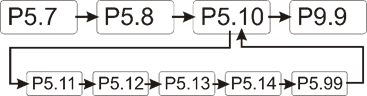
This section supplements the “LIS-SV”
product manual. The parameters described here are only available if the LIS-SV
is used in an ABULiner control unit.
Overview of the
'ABULiner' parameter level
The following parameters can be set in the 'ABULiner'
parameter level of the LIS-SV.
|

|
Danger during setting work!
During setting work on the LIS-SV, monitoring of
the wire rope hoist is switched off. This means the wire rope hoist cannot
be monitored for excess load, among other things. This means the
wire rope hoist cannot be monitored for excess load, among other
things.
This in turn means the load could fall and kill or
injure people!
Do not use the crane for normal work during
setting work, and only lift loads very carefully for test
purposes! |
All LIS-SV parameters which are important for the ABULiner
are combined in a separate parameter level, which is shown as a submenu.
 Move the load hook out of
the limit switch range (up or down).
Move the load hook out of
the limit switch range (up or down).
During parameter setting, the load hook must not be within the
limit switch range.
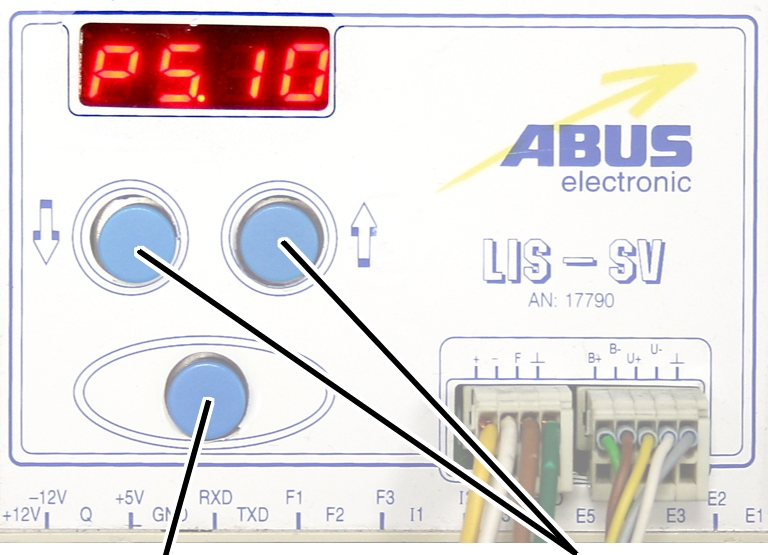
Open the menu of the
LIS-SV. See the documentation “Load indicator system LIS-SV”.
|
|
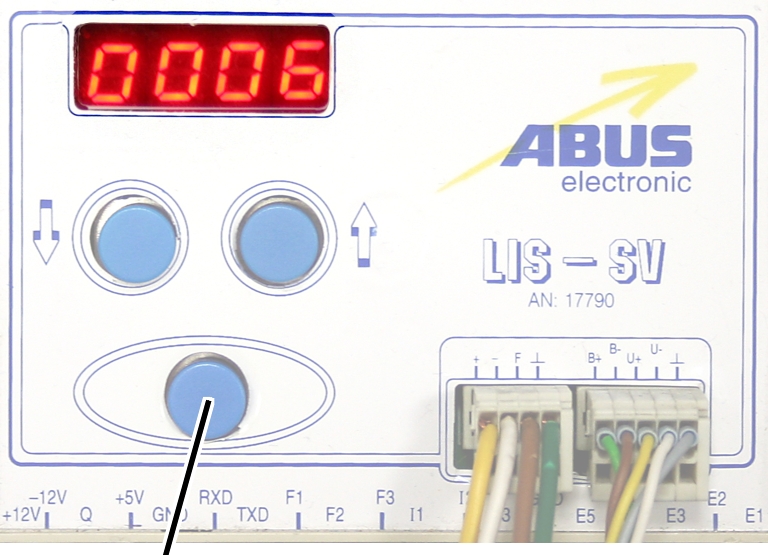
|
Enter
button |
Arrow
buttons |
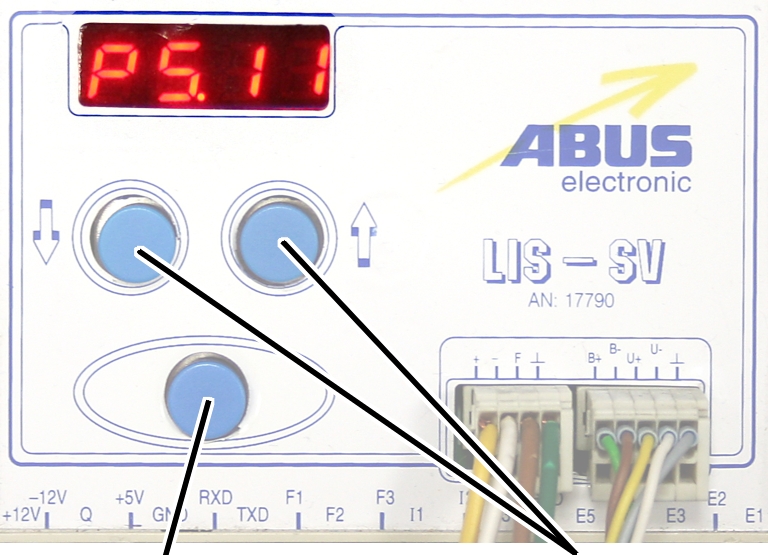
 Select parameter 5.10.
Press ENTER.
● The
'ABULiner' parameter level is activated.
● Parameter
5.11 is displayed.
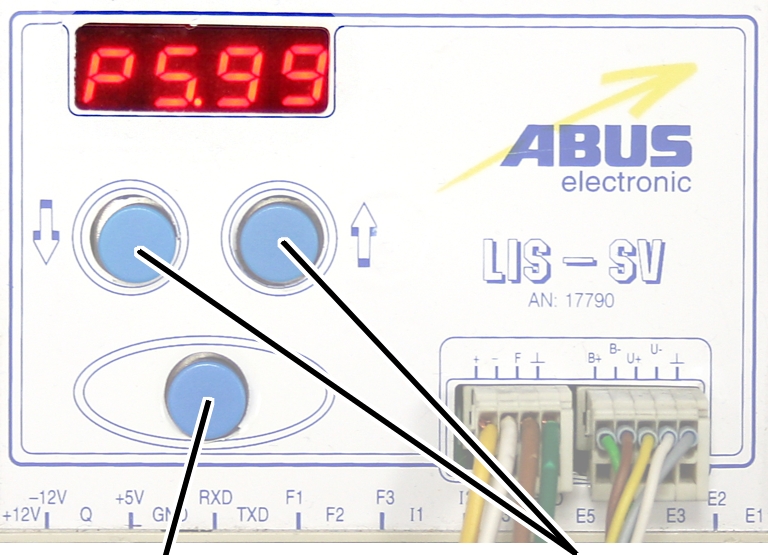
Exiting the
'ABULiner' parameter level
|
|
|
Enter
button |
Arrow
buttons |
Select parameter 5.99.
Press ENTER.
● The
previous parameter level is reactivated.
● Parameter
5.10 is displayed.
The LIS-SV is automatically activated for the ABULiner if a
value is entered for the parameter 5.11.
In the ABULiner mode (a value is set for parameter 5.11):
─ The
LIS-SV can monitor the total load for a maximum of two wire rope hoists.
─ Input F3
(normally used for measuring the load of wire rope hoist 3) now serves in
monitoring the current rotational frequency of the hoist motor.
─ A value
can be entered for parameter 3.0 (maximum load capacity of wire rope hoist 3).
If a value is entered for this, parameter 5.11 cannot be set.
─ This
interlocking thus excludes an incorrect setting.
─ The
load-controlled switching point at output TxD of the LIS-SV cannot be used.
─
Parameter 4.5 (setting for load-controlled switching point) is not available.
In the normal mode (no value is set for parameter 5.11):
─
Operation of the ABULiner Lifting/Lowering unit is not possible.
─ The
LIS-SV can monitor the total load for up to three wire rope hoists.
─ Input F3
serves in measuring the load of a third wire rope hoist.
─ A value
can be entered for parameter 5.11 (gear ratio). If a value is entered for this,
parameter 3.0 cannot be set.
─ This
interlocking thus excludes an incorrect setting.
─ The
load-controlled switching point at output TxD of the LIS-SV can be used.
─
Parameter 4.5 (setting for load-controlled switching point) can be used.
The LIS-SV uses the signal of the encoder and the gear ratio
of the hoisting gear to calculate the hook travel distance, the maximum distance
in the limit switch range and the current rotational frequency of the hoist
motor. The gear ratio must be set on the machine.
|
|
|
Cable
speed |
|
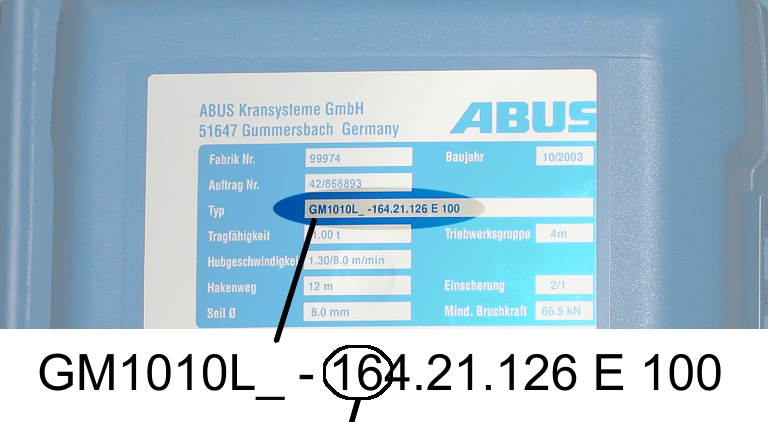
Read off the type
designation at the type plate of the wire rope hoist.
Read off the cable
speed.
From this table, select
the gear ratio that matches the cable speed.
|
|
Cable
speed |
|
Hoist motor GM |
32 m/min at 50 Hz
38 m/min at 60
Hz |
25 m/min at 50 Hz
30 m/min at 60
Hz |
20 m/min at 50 Hz
24 m/min at 60
Hz |
16 m/min at 50 Hz
19 m/min at 60
Hz |
|
800.4 |
50.01 |
63.49 |
77.77 |
98.16 |
|
800.5 |
47.03 |
60.04 |
74.66 |
95.03 |
|
1000.6 |
54.43 |
68.91 |
84.00 |
105.1 |
|
1000.7 |
54.60 |
68.06 |
81.45 |
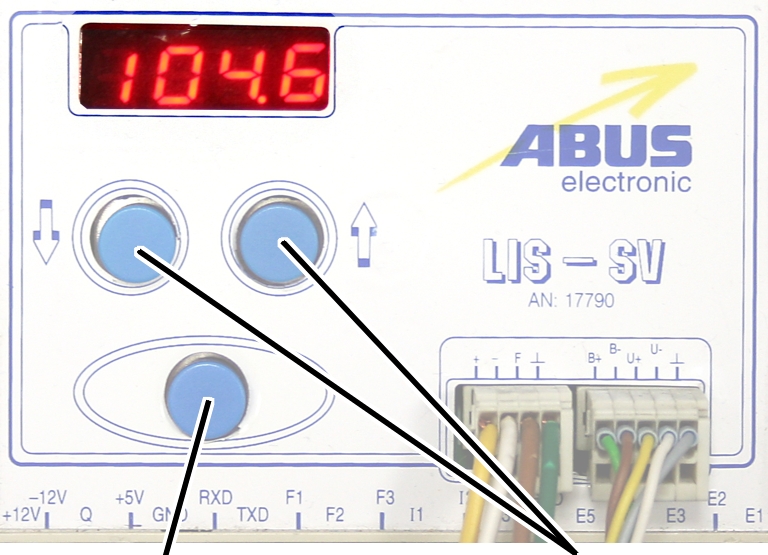
104.6 |
|
2000.3 |
58.22 |
74.23 |
91.19 |
118.4 |
|
3000.4 |
73.61 |
93.92 |
118.4 |
152.9 |
|
5000.3 |
85.14 |
109.3 |
132.8 |
169.0 |
|
5000.4 |
80.20 |
104.9 |
127.7 |
160.6 |
|
6000.3 |
94.69 |
118.5 |
149.6 |
182.7 |
|
7000.1 |
118.0 |
148.3 |
182.6 |
232.0 |
|
|
|
|
|
|
Table: Gear ratios (numerical values) depending on
hoist motor (lines) and cable speeds (columns) at 50 and 60 Hz.
|
|
|
Enter
button |
Arrow
buttons |
Move the load hook out of
the limit switch range (up or down).
During parameter setting, the load hook must not be within the
limit switch range.
Select parameter 5.11.
Press ENTER.
● The set
value is displayed.
If the value is 0.00, the function is deactivated.
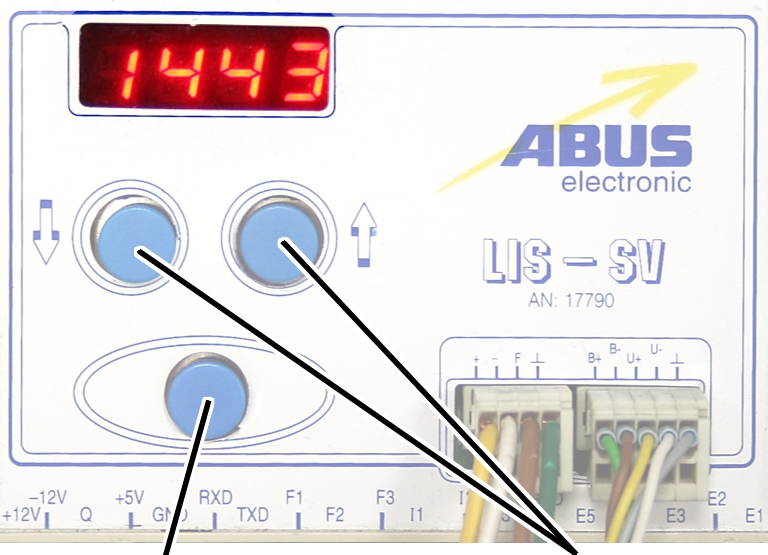
● Hold ENTER
pressed.
● CODE is
displayed.
Hold ENTER pressed.
|
|
|
Enter
button |
Arrow
buttons |
Enter the code 1443.
Press ENTER briefly.
|
|
|
Enter
button |
Arrow
buttons |
Set the value from the
table.
If the display ‘0.00’ cannot be changed, a value is set in
parameter 3.0. In this case, set the value to zero first.
Press ENTER briefly.
My | Webcamxp Server 8080 Secret32 Best [verified]
To get the "best" out of your 8080 server, you must optimize the stream for your specific bandwidth: Support - webcamXP
These alternatives may have different default security postures and configuration requirements, so always review their documentation carefully before deployment.
Google dorks are advanced search queries that take advantage of Google's powerful indexing capabilities to find specific types of web pages. For WebcamXP, hackers might use queries such as:
The combination of default page titles, default port numbers, and weak or non-existent authentication has made WebcamXP servers a favorite target for security researchers, curious teenagers, and malicious actors alike. The process of discovering and accessing vulnerable webcams is alarmingly simple, thanks to specialized search engine queries often called "Google dorks" or "Google hacking." my webcamxp server 8080 secret32 best
: To access your stream from outside your local network, you must log into your router and forward port 8080 to the internal IP address of the PC running WebcamXP. : Add an exception in Windows Firewall for webcamxp.exe to prevent blocked connections. Securing Your Stream with "Secret32"
Regularly check the WebcamXP connection logs. Look for repeated failed login attempts or unfamiliar IP addresses, which indicate that a malicious actor is attempting to brute-force your 32-character secret key.
If you are determined to use WebCamXP, you must operate with a security-first mindset. Treat it like a bank vault, not a toy. To get the "best" out of your 8080
Setting up a private video streaming network requires a blend of speed, stability, and data privacy. stands out as a highly resilient and lightweight Windows tool designed to transform a standard workstation into a dedicated local security or live-streaming node.
Restrict general access so that the stream cannot be viewed unless the exact string or token is appended to the stream request URL. 3. Router Port Forwarding
You’ve now built a fully functional, secure, and optimized WebcamXP server using the configuration hinted at by “my webcamxp server 8080 secret32 best”. By selecting port 8080, you avoided common conflicts and ISP blocks. By adopting a strong 32-character password (the “secret32” principle), you protected your feed from intruders. And by following our best practices – including DDNS, motion detection, and regular maintenance – you’ve ensured the best possible streaming experience. The process of discovering and accessing vulnerable webcams
To optimize your on port 8080 , you need to balance remote accessibility with high-end security. WebcamXP is a widely used surveillance software for Windows that transforms a standard PC into a security system by broadcasting live video over the internet.
To get the best performance and security out of your WebcamXP deployment, follow this structured configuration workflow. 1. Configure the Web Broadcast Settings Open the application interface. Navigate to the Web Broadcast or Internal Server tab. Locate the Port field and change it from 80 to 8080 .
Only for auxiliary fans
The auxiliary fan of the hoist motor continues to run for
several minutes after the lifting or lowering. This ensures that the hoist motor
is adequately cooled even at slow lifting speeds. The run-on time can be
adjusted.
|
|
|
Enter
button |
Arrow
buttons |
Move the load hook out of
the limit switch range (up or down).
During parameter setting, the load hook must not be within the
limit switch range.
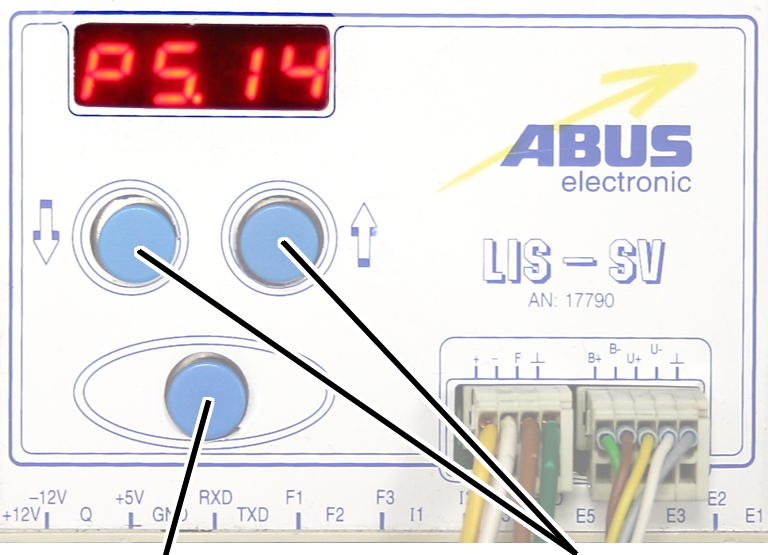
Select parameter 5.14.
Press ENTER.
● The set
value is displayed.
|
|
|
Enter
button |
|
Set the value to between 3
and 10 minutes using the arrow buttons.
Press ENTER.