Peter's electronic projects Peter's electronic projects
 Try it now, before building! Click on the transmitter buttons with the
green
labels
on the left and see how the receiver outputs (K1-K8) change. Change
the number of transmitter or receiver channels. Switch the receiver
output type between latched and momentary.
Try it now, before building! Click on the transmitter buttons with the
green
labels
on the left and see how the receiver outputs (K1-K8) change. Change
the number of transmitter or receiver channels. Switch the receiver
output type between latched and momentary.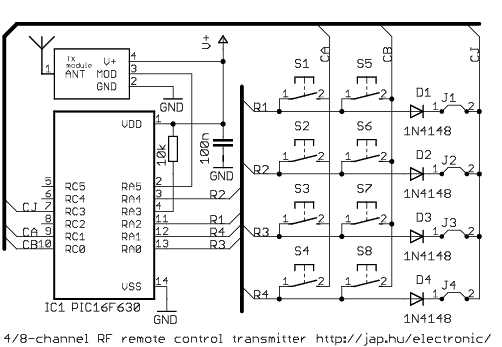
| part | description |
| C1 |
100nF ceramic capacitor |
| R1 |
10k resistor (1/8W) |
| D1-D4 | 1N4148 diode (optional) |
| S1-S8 |
tact switch, DTSM 61N or similar |
| IC1 | PIC16F630 or PIC16F676 microcontroller, pre-programmed |
| TXMOD |
radio
transmitter module, see text (hardware) |
| B1 |
battery between 2-5.5VDC (check TXMOD specs for valid voltage range) |
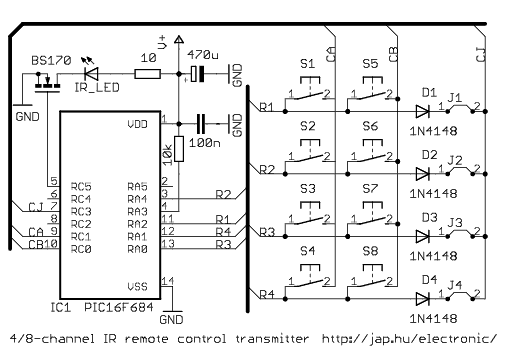
| part | description |
| C1 |
100nF ceramic capacitor |
| C2 |
470 uF 6.3V, electrolytic
capacitor |
| R1 |
10k resistor (1/8W) |
| R2 |
10 ohm resistor (1/4W) |
| D1-D4 | 1N4148 diode (optional) |
| D5 |
IR transmitter LED |
| Q1 |
BSS138 or similar N-MOSFET |
| S1-S8 |
tact switch, DTSM 61N or similar |
| IC1 | PIC16F684 microcontroller, pre-programmed |
| B1 |
battery between 2-5.5VDC (CR2032, 3.6V LiIon battery or 3xAA
batteries) |
| please
observe the corresponding address configuration! |
|
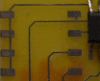 transmitter: no diodes connected |
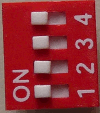 receiver: switches all ON |
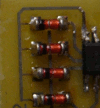 transmitter: all diodes connected |
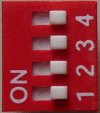 receiver: switches all OFF |
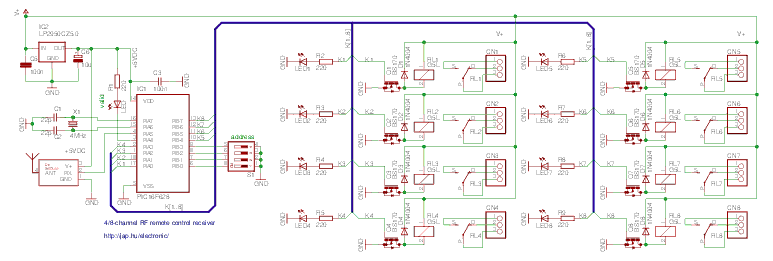
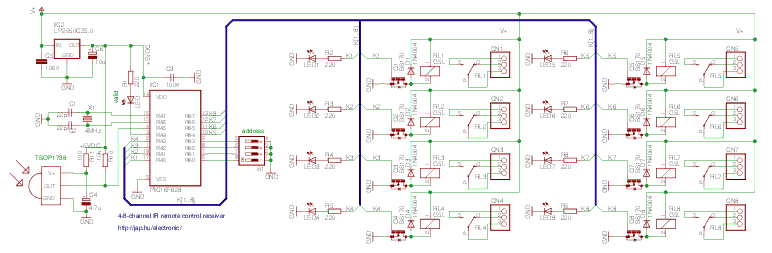
parts list
| part | description |
| C1, C2 | 22pF ceramic capacitor |
| C3, C5 | 100nF ceramic capacitor |
| C6 | 10uF 6.3V electrolytic capacitor |
| CN1-CN8 | PCB terminal block, 3-way (DG301) |
| D1-D8 | 1N4004 diode |
| IC1 | PIC16F627 or PIC16F628 or PIC16F627A or PIC16F628A microcontroller, pre-programmed |
| IC2 | LP2950CZ5.0 voltage regulator |
| LED | 3mm LED (green) |
| LED1-LED8 | 3mm LED (red) |
| Q1-Q8 | BS170 N-channel mosfet transistor |
| R1-R9 | 220R resistor (1/8W) |
| RL1-RL8 | G5LE relay, see text for coil voltage selection |
| S1 | piano DIP switch, 4-way |
| X1 | 4MHz HC49 crystal |
| RXMOD | 3-pin radio receiver module, see text (hardware) |
| please
observe the corresponding address configuration! |
|
| transmitter: no diodes connected |
receiver: switches all ON |
| transmitter: all diodes connected |
receiver: switches all OFF |
– Added the Magic Wand tool in 3D views and better solid element operations (subtract, intersect, union) for complex modeling.
Mr. Alden was silent for a long time. Then he smiled. "You finally built the garden."
ArchiCAD 14 changed the competitive landscape of BIM software. By proving that an open ecosystem could match or outperform closed, proprietary ecosystems, it forced competitors to improve their own IFC import and export capabilities.
ArchiCAD 14 introduced native coordination workflows with major engineering packages like Tekla Structures and Revit Structure. This integration allowed for automated clash detection, ensuring that pipes, ducts, and structural beams did not conflict with the architectural layout before construction began. 4. Productivity and Documentation Enhancements archicad 14
ArchiCAD 14 was well-received for making BIM more presentable and flexible. It bridged the gap between pure modeling and polished construction documents, though later versions (15, 16) further refined these tools.
The ability to handle multiple layers and views allowed for the easy management of complex projects, ensuring that structural, electrical, and architectural elements could be shown or hidden as needed.
💡 : If you are still using Archicad 14 for legacy projects, ensure your hardware maintains compatibility with older 32-bit and 64-bit architecture, as modern operating systems may require virtualization to run it smoothly. If you're interested, I can: Compare Archicad 14 features with the latest version Provide a list of system requirements for older versions Explain the Open BIM concept in more detail AI responses may include mistakes. Learn more – Added the Magic Wand tool in 3D
to bridge the different modeling requirements of architects and structural/MEP engineers. Refined Productivity Tools: Shadow Casting in Open GL:
Before ArchiCAD 14, software interoperability was a significant hurdle in the construction industry. Architectural practices often struggled to share complex 3D data with engineers who utilized different platform ecosystems. Graphisoft addressed this bottleneck directly by optimizing the software around the IFC (Industry Foundation Classes) workflow. Teamwork 2.0 Integration
Introduction Graphisoft released ArchiCAD 14 in 2010, introducing a major shift in the Building Information Modeling (BIM) landscape. The software arrived during a critical industry transition. Architecture and engineering firms were rapidly moving away from traditional 2D drafting toward fully integrated 3D workflows. Marketing teams branded this specific release with the tagline "The Open BIM Experience." It focused heavily on collaboration, data exchange, and workflow integration between architects and engineers. Then he smiled
For many firms, Archicad 14 represents a classic, stable version that perfected the core BIM functionalities while introducing revolutionary collaboration tools. The Core Philosophy: OpenBIM and Teamwork 2.0
Improvements were made to the library part management, the renovation tool (which helped manage existing, demolished, and new construction), and the "Element Schedules" which became more flexible for quantity take-offs. Impact on the Industry
ArchiCAD 14: Unlocking the Power of Collaborative BIM and Green Design
LATCH_MASK EQU B'00001111' sets channels 8-5 to momentary
and
channels 4-1 to latched (toggle) mode. Then use the compiler (MPLAB or
gputils) to
assemble the code.clrf
0x91 ;
ANSEL