System Design Interview Alex Xu Volume 2 Pdf Github Upd [work] -
Merge connects Wear OS watches to iPhones, so you can enjoy the watch you truly love.


Merge connects Wear OS watches to iPhones, so you can enjoy the watch you truly love.
Seamless communication over Bluetooth

Scan the QR code with your iPhone, or search the App Store for "Merge Android".

Search for "Merge" in Google Play on your Wear OS watch.
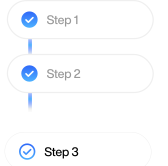
The two apps will connect your devices over Bluetooth.
Using two phones? Connect your Android watch to both your iPhone and Android phone simultaneously to get the best of both worlds.

The book provides a structured approach to system design interviews, including:
Use a pull-based metrics collection model to avoid overwhelming the monitoring system, and employ sliding-window algorithms for real-time alerting rules. How to Leverage GitHub for System Design Preparation
Focus on specific technical challenges and bottlenecks. Wrap Up: Summarize and discuss potential improvements. Official Resources vs. GitHub/PDF Searches
Many candidates search for community-curated repositories and updated tracking logs on platforms like GitHub to streamline their preparation. Understanding the core architecture patterns, real-world case studies, and advanced engineering trade-offs presented in Volume 2 is essential for modern technical loops. 📌 Core Frameworks and Foundational Shifts
The you find most challenging (e.g., Payments, Metrics, Maps?) Your interview timeline system design interview alex xu volume 2 pdf github upd
to handle ambiguity, stressing the importance of asking the right clarifying questions and engaging the interviewer in a collaborative design session. Key System Design Scenarios
Volume 2 distinguishes itself by focusing on 13 intricate system design problems, each with a detailed solution. The book is structured around a clear, step-by-step framework, supported by over 300 diagrams that make complex architectures approachable.
This is where Volume 2 shines. You must drill down into the specific bottlenecks of the system. For a payment system, this means discussing tokenization and ledger idempotency. For a mapping app, it means discussing how to shard data based on location. Step 4: Wrap Up and Identify Bottlenecks
If designing Google Maps, focus on how map data is partitioned and how the routing engine works. The book provides a structured approach to system
| Chapter | Topic | |---------|-------| | 1 | Proximity Service (Yelp, Uber Eats) | | 2 | Nearby Friends (real-time location) | | 3 | Google Maps | | 4 | Distributed Messaging Queue (Kafka-like) | | 5 | Distributed Metrics/Monitoring (Prometheus) | | 6 | Ad Click Aggregation (real-time analytics) | | 7 | Hotel Reservation (concurrency, race conditions) | | 8 | Distributed Locking (ZooKeeper/etcd/Redis) | | 9 | Payment System (idempotency, ledger) | | 10 | Cloud Storage (Dropbox/Google Drive) |
SQL and NoSQL database schemas for the payment system to handle double-spending. 2. Community-Driven Updates and Errata
A system design interview is a type of technical interview that evaluates your ability to design a system that meets specific requirements. The interviewer will provide a scenario or a problem, and you'll be expected to design a system that solves it. The system can be a software application, a distributed system, or even a hardware component.
Explore how to design data pipelines using Trie data structures to serve real-time search suggestions with sub-millisecond latency. Navigating GitHub for Summaries and Code Implementations Official Resources vs
[Volume 1: Fundamental Blocks] ──► [Volume 2: Deep Component Integration] (Rate Limiters, Basic ID Gen) (Geo-replications, Event-Driven Topologies) Key Engineering Shifts
Alex Xu’s books are largely conceptual. The GitHub community fills this gap by publishing actual implementations of these systems. You can find repositories containing: Geohash calculation scripts in Go or Python. Rate-limiting algorithms implemented in Redis Lua scripts.
: Caching the top-k results directly at each trie node to eliminate real-time traversal latency, and updating the trie asynchronously via offline MapReduce or Spark analytics pipelines. 5. Payment System
Graph processing, routing engines, and segmenting maps into smaller tiles for fast mobile rendering. 3. Distributed Message Queue (Kafka Clone)
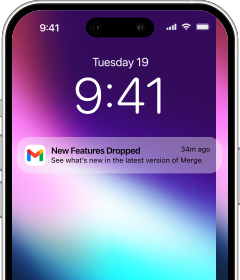
Stay in the loop! Get email updates when we launch exciting new features and capabilities for Wear OS or watchOS. Unsubscribe at any time.