Final Dev Letter & FAQ
2025-01-29
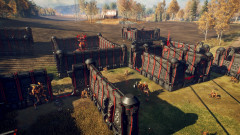
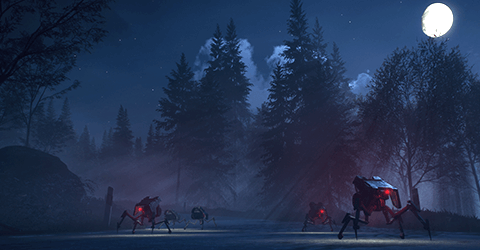
Explore a vast open world, rendered with the award-winning Apex engine, featuring a full day/night cycle with unpredictable weather, complex AI behavior, simulated ballistics, highly realistic acoustics, and a dynamic 1980’s soundtrack.
Experience an explosive game of cat and mouse set in a huge open world. In this reimagining of 1980’s Sweden, hostile machines have invaded the serene countryside, and you need to fight back while unravelling the mystery of what is really going on. By utilizing battle tested guerilla tactics, you’ll be able to lure, cripple, or destroy enemies in intense, creative sandbox skirmishes.
Go it alone, or team-up with up to three of your friends in seamless co-op multiplayer. Collaborate and combine your unique skills to take down enemies, support downed friends by reviving them, and share the loot after an enemy is defeated.
All enemies are persistently simulated in the world, and roam the landscape with intent and purpose. When you manage to destroy a specific enemy component, be it armor, weapons or sensory equipment, the damage is permanent. Enemies will bear those scars until you face them again, whether that is minutes, hours, or weeks later.
When working with the game engine (commonly used for visual novels) and emulators like Kirikiroid2 on Android, patch.tjs and xp3filter.tjs are two of the most critical files for customizing or fixing game behavior.
Commercial visual novel developers rarely leave their assets bare; they apply custom cryptography algorithms to their .xp3 archives to protect intellectual property from simple asset ripping. The xp3filter.tjs file is an explicit, on-the-fly . It hooks into the engine's standard file-reading interface, intercepting encrypted bytes as they flow into memory, decrypting them via a game-specific math matrix, and feeding the clean, readable data directly to the emulator. Common Implementation Scenarios
This function sets a custom filter for extracting data from .xp3 archives. The parameters are:
(请注意:本文提及的技术及文件仅用于合法备份或游戏修改学习,请勿将相关技术用于侵犯版权的行为。尊重开发者与汉化组的劳动成果,才能让我们热爱的圈子走得更远。)
patch.tjs and xp3filter.tjs represent the modder’s ability to interact with a closed-source engine without needing its original toolchain. patch.tjs provides the power of file overriding; xp3filter.tjs provides the precision of per-file manipulation. Together, they transform the Kirikiri engine from a static black box into a modular, modifiable platform. For anyone looking to translate, debug, or customize a visual novel built on this engine, understanding these two files is not just helpful—it is essential. They are the silent scripts that give new life to old games, proving that even in a compiled world, high-level scripting remains the key to interoperability and preservation.
In the world of software development, there are numerous tools and technologies that make our lives easier. Three such tools that have gained significant attention in recent years are Patchtjs, XP3Filter, and TJS. In this article, we will explore the ins and outs of these technologies, their uses, benefits, and how they can be leveraged to improve your development workflow.
are critical script files used to enable compatibility for encrypted or modified games. Core Definitions xp3filter.tjs : This file is primarily used for decoding encrypted .xp3 archives
: Embedded image layers, UI graphics, sound design, and character logic.
While patch.tjs is a blunt instrument (override everything in a certain folder), xp3filter.tjs is a scalpel. This file contains a class that implements custom logic for how the engine reads files from .xp3 archives. It acts as a filter, intercepting each open or read request.
If you run into any trouble, the first step is always to double-check that you have the correct patch for your specific game. Happy gaming!
These scripts are specific to the Kirikiri (TJS2) engine. Incorrect syntax can cause game crashes.
Read the latest news from the Generation Zero development team.